PREDICTIVE MODELING OF FATAL OUTCOMES IN COMMERCIAL AVIATION ACCIDENTS

Image Source: California Aeronautical University
Role
Skills
time line
Full project
The Overview
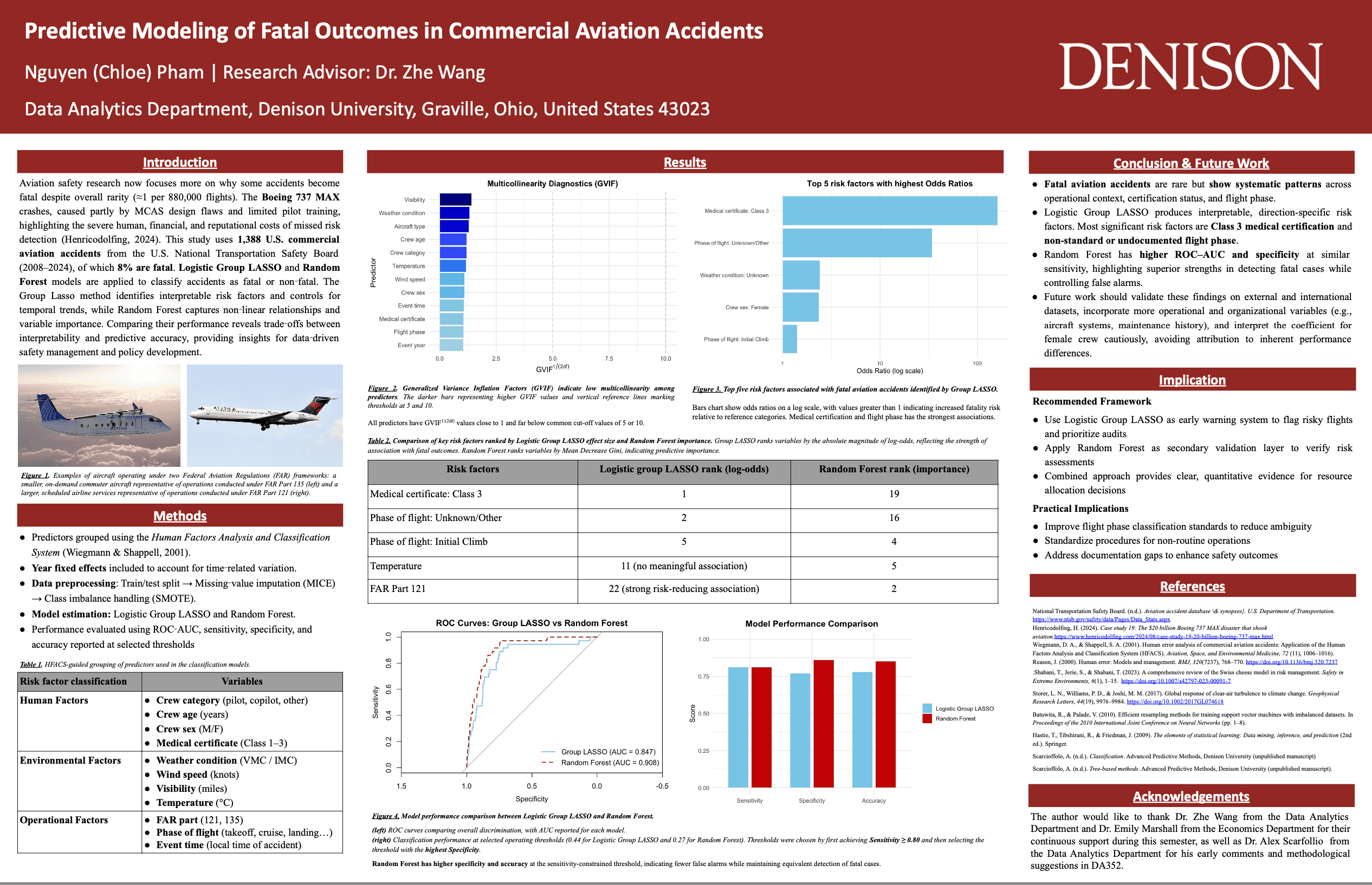
This project predicts fatal outcomes in commercial aviation accidents using 16 years of NTSB data (2008–2024, n=1,388). The goal is to identify which factors correlate with the occurrence of fatal accidents and use Logistic Regression and Random Forest concurrently. Ultimately, this project aims to help safety teams prioritize life-saving interventions.
the development
Data Collection: Analyzed 1,388 U.S. commercial aviation accidents from NTSB data (8% fatal). Focused on commercial aviation for its standardized FAA oversight, training protocols, and safety systems, ensuring high-quality, consistent data for modeling.
Variable Organization: Applied the HFACS framework to categorize predictors as Human, Environmental, or Operational factors, ensuring interpretable and actionable results.
Data Preparation: Cleaned variables, used MICE imputation for missing data, applied SMOTE for class imbalance, and assessed multicollinearity with GVIF.
Dual-Model Approach: Developed Logistic Group LASSO to explain why accidents become fatal through interpretable risk factors, and Random Forest to predict and prioritize high-risk cases through nonlinear pattern detection.
Model Evaluation: Compared performance using ROC-AUC with safety-first thresholds (Sensitivity ≥ 0.80, maximized specificity). Interpreted results through variable importance to identify key fatality drivers.
the takeaways
Fatal outcomes follow consistent patterns, particularly in relation to operational context (FAR Part) and flight phase.
Model Performance:
Random Forest achieved higher predictive accuracy (AUC), making it optimal for prioritizing high-risk cases for investigation.
Logistic Group LASSO provided interpretable, defensible risk explanations, ideal for early-warning systems and stakeholder communication.
Application: Use the interpretable model to flag and explain risk, then apply the high-performing model to confirm and prioritize interventions. Limitations include data constraints from rare fatal events and unavailable organizational/technical variables.

©2026 design